Tuesday, June 7, 2016

EU considering working with Sudan and Eritrea to stem migration | World news | The Guardian


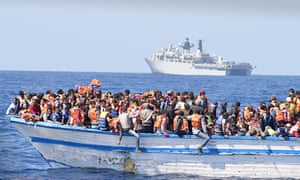
369 migrants crammed into a heavily overcrowded wooden hulled boat which was located in the waters just north of Libya.
 369 migrants crammed into a heavily overcrowded wooden hulled boat which was located in the waters just north of Libya. Photograph: MOD/REX Shutterstock


Europe is considering whether to forge ahead with a plan to work with repressive African regimes in an attempt to stem migration flows, according to the draft version of a policy expected to be finalised by European officials on Tuesday.
To stop refugees reaching southern Europe from Africa, Europe is mulling whether to partner with Sudan, whose president is wanted for war crimes, and Eritrea, whose government is accused of crimes against humanity by the UN.


Both countries are a significant source of refugees in Europe, while Sudan is also a major migration thoroughfare for people moving between east Africa and the Libyan coast, the springboard for most people-smuggling missions to Italy. Over 150,000 people reached Europe from Libya in 2015 – only slightly fewer than the record of 170,000 in 2014.
In a draft document seen by the Guardian ahead of its official release by European civil servants on Tuesday, the EU has pledged to go ahead with a project that could see Europe provide Sudan’s security services with more equipment and funds to stop refugees, as well as assisting Eritrea’s judiciary.
The text has yet to be finalised, and EU sources could not confirm that the sections concerned would be kept in the text when it is officially published on Tuesday. The plans are only the latest iteration of a new EU migration strategy still being fleshed out by European leaders.
The proposed strategy also includes sending more aid and technical assistance to about 20 countries including Jordan, Lebanon, Niger, Libya and Ethiopia, in a bid to persuade their governments to do more to curb irregular migration.
Following a fall in the number of people reaching Europe from Turkey, European leaders are now trying to curb migration from elsewhere in the region. Favourable trade deals and visa liberalisation programmes are among the suggested ways of winning the acquiescence of target countries. Vague reference to legal pathways for refugees to Europe, as well as increased job opportunities for refugees left behind in Africa and the Middle East, are also included among the so-called “country packages”.
But buried deep within the draft document, the most eye-catching announcement concerns the EU’s “Better Migration Management” project, which the draft suggests “will start this summer”.
The project was first floated publicly in December, and according to documents released at the time could involve the provision of cars, equipment and possibly aircraft to the Sudanese government – as well as “capacity-building” for Eritrean judges, whom the UN accuses of aiding and abetting President Isaias Afwerki’s despotic regime in Asmara.
The proposals have been met with fury by some rights campaigners and leftwing MEPs. Barbara Spinelli, an Italian MEP from GUE/NGL, a leftwing coalition in the European parliament, said: “These ‘country packages’ would make us complicit with dictatorships and deny basic fundamental rights to people fleeing wars, famine and extreme poverty … The commission should be ashamed of this proposal.”
Sara Tesorieri, a policy adviser at Oxfam, accused EU leaders of compromising European values, should the proposals come to pass on Tuesday. She said: “The EU needs to reconsider very carefully exactly how much it is willing to sacrifice on the altar of migration, because right now, they are headed down a road where they will have a foreign policy that consists of a single objective. And they will be bargaining with regimes that they have held at arm’s length.”
She added the EU “should be rethinking its approach. It needs to return to reframing migration as an opportunity. The reality is that migration is increasing globally and Europe is going to be part of that.”
A spokesperson for the European commission said: “There are also no [concrete] plans at this stage to provide equipment to the Sudanese government. Any decision to provide civilian equipment will be taken on the basis of a forthcoming appraisal mission to Sudan from the EU and the consortium of EU member states.”
The German development minister, Gerd Müller, last week told the Guardian that Germany had no plans to send money to Sudan, contrary to reports in Der Spiegel and statements within EU policy documents, including the draft seen by the Guardian.


Tuesday’s policy paper is only the latest attempt by the EU to stem the flow of people arriving on Europe’s shores. At a summit in Valletta last November, the EU promised to give 23 African nations a share in a €1.8bn (£1.4bn) “trust fund”, money for employment projects and border controls to dissuade people from travelling to Europe.
Some countries would like to see the EU go further, with a tougher approach to refugees. Austria’s foreign minister, Sebastian Kurz, has called for asylum seekers to be kept on islands rather than having direct access to the continent. In aninterview with Die Presse on Sunday, he urged the EU to follow the Australian model, where migrants and refugees are sent to Pacific island detention centres, where they are held indefinitely, while their asylum applications are processed.
Hungary, a staunch opponent of plans to redistribute refugees around the bloc, had already proposed that refugees be restricted to “closed and protected” centres beyond the EU’s borders.

Thursday, May 26, 2016

Sudan and Eritrea crackdown on migrants amid reports of EU incentives


Authorities in Sudan have launched a crackdown on Eritrean migrants - arresting those living in the capital, Khartoum, and intercepting hundreds travelling north through the country towards Libya, the launching point for smugglers’ boats heading for Europe.
Reports that 900 Eritreans were rounded up in Khartoum on Monday and that a further 400 arrested en route to Libya have been deported to Eritrea, come amid recent revelations in the British and German media that the EU is planning to deepen its cooperation with a number of African countries, including Sudan and Eritrea, to stem migration towards Europe.
Kibrom*, a 16-year-old Eritrean refugee who used the route through Sudan and Libya to reach Europe in 2015, told IRIN that his twin sister was among a group of 130 Eritreans captured by Sudanese soldiers in the town of Dongola, about halfway between Khartoum and the Libyan border, earlier this month.
“I passed the same way. When we were travelling, we had to bribe the police. My sister used the same smuggler, but when he tried to bribe the police, it didn’t work,” he said.
Kibrom’s sister, along with the rest of the group, were taken to a prison in Khartoum where they spent three days. Kibron said he tried to alert the UN’s refugee agency, UNHCR, but failed to make contact.
“Only the Eritrean Embassy was informed. They took them in an open truck at night time to the Eritrean border,” he said. “From there they were taken to a prison located in my city – Teseney.”
Leaving Eritrea without permission is a criminal offense and Kibrom is extremely concerned about his sister, who was trying to evade military conscription, as well as his mother and two younger brothers who are still living in Teseney.
“My mother can’t even try to see my sister or she will be arrested as well,” he told IRIN over the phone from Sweden where he has applied for asylum. “I’m so worried what’s going to happen to them.”
A spokesperson with UNHCR’s office in Khartoum confirmed that a number of migrants, including Eritreans, had been intercepted in northern Sudan heading towards the Libyan border. Of those being held at the Aliens Detention Centre in Khartoum, UNHCR had only identified six individuals who had previously sought asylum and been recognized as refugees.
None of those six had been deported and the spokesperson did not comment on the other deportations but said: “If an individual does not apply for asylum through the channels provided and subsequently does not express a wish to seek asylum, Sudan may be within its legal right to pursue deportation of irregular migrants from its territory.
“For UNHCR, the principle prohibiting forcible returns or non-refoulement only takes centre stage when the affected individuals are persons of concern to UNHCR, which does not appear to be the case in this particular instance.”
It is unclear whether UNHCR had access to all of the Eritreans detained in Khartoum prior to their deportation. Meron Estefanos, an Eritrean activist based in Sweden who has been in touch with the relatives of some of the deportees, told IRIN that another group of around 300 Eritreans arrested while making their way to Libya were deported last Friday.
Sudan has a prior record of deporting Eritreans without allowing them access to asylum procedures, a practice that UNHCR has condemned in the past as amounting to refoulement.

Increased border controls

In addition to the arrests of migrants in Sudan, Estefanos said there has also been a noticeable increase in controls on the Eritrean side of the Sudan-Eritrea border in the last two months. “Leaving Eritrea to Sudan is becoming hard now,” she told IRIN. “People are being intercepted and sent back.”
Last year, a UN inquiry found evidence that Eritrea is a totalitarian state responsible for “systemic, widespread and gross human rights violations” including a system of indefinite national service that amounts to forced labour.
Eritrean soldiers are instructed to shoot at anyone they discover trying to leave the country illegally, a policy that hasn’t prevented thousands from fleeing across the border every month. While the majority of Eritreans remain in camps in Sudan and Ethiopia, over 70,000 applied for asylum in Europe during 2014 and 2015, according to EuroStat figures.
Last week, Der Spiegel and the New Statesman reported on a leaked plan to increase cooperation with African countries of origin and transit for migrants. The articles alleged that the EU plans to use funding from the recently launched Emergency Trust Fund for Africa to send equipment and vehicles to help Sudan police its border with Eritrea and to assist with the construction of two closed reception centres in Gadaref and Kassala. Eritrea would be given assistance to develop or implement human trafficking regulations.
A spokesperson with the EU’s Office for International Cooperation and Development, said the reports were inaccurate and that there are currently no plans to provide equipment to the Sudanese government, or to help them build reception centres.
“Any decision to provide civilian equipment will be taken on the basis of a forthcoming appraisal mission to Sudan from the EU,” she said, adding that any future donation of equipment would comply with EU sanctions against Sudan, which include a ban on the provision of services related to military activities.
“The activities related to Sudan are part of a broader regional project in the Horn of Africa, worth EUR 40 million, financed under the EU Trust Fund for Africa and designed to improve migration management,” said the spokesperson, noting that the main objective was to cooperate on fighting trafficking and smuggling.
“No funding will be channelled through the beneficiary countries’ government structures.”

EU outsources migration policy

The EU has increasingly sought the cooperation of African states to control the flows of migrants headed for its shores by using the promise of aid and trade agreements. Critics argue that such policies have contributed to states viewing migrants as bargaining chips to be leveraged for maximum political capital with disastrous results for their safety and human rights.
Europe’s engagement with Sudan and Eritrea, and other countries along the Horn of Africa to Europe migration route, dates back to the Khartoum Process, launched in November 2014. The EU spokesperson said such initiatives were important for “keeping a dialogue going” with the otherwise isolated Eritrean regime.
Shagarab Camp - Turmesgy Gabr Selassie (right) fled the Eritrean army 3 months ago. He shares this tent with 11 other men and women where they sleep on the ground. The only luxury in their tent is the thin sheets with which they cover themselvesBut sceptics argue that the Khartoum process risks legitimizing the governments of Sudan and Eritrea by treating them as partners in tackling irregular migration, when in fact those countries’ own policies are a major factor in driving migration and fuelling migrant smuggling and trafficking. Sudanese officials have repeatedly been accused of colluding with or turning a blind eye to traffickers who kidnap Eritrean refugees and hold them for ransom.
A former journalist from Eritrea, who asked not to be named, said that Eritrea’s stepped up border controls were partly related to security concerns as it celebrates 25 years of independence, but that they were also about “trying to make themselves look like a good partner” to the EU.
“They’re helping the trafficking networks become smarter, because people will still look for a way out,” he told IRIN. “If these people stay in power, there’s no way to stop migration.”
*Not his real name

Wednesday, May 18, 2016

In Attempt to Manage Refugee Crisis, E.U. Seeks to Work With Repressive African Gov’ts


By James Carstensen | May 17, 2016 | 10:54 PM EDT


Sudanese President Omar al-Bashir is wanted by the ICC for war crimes and genocide. (AP Photo, File)
Berlin (CNSNews.com) – European Union proposals to stem the flow of migrants from Africa by cooperating with African countries – including those ruled by despotic governments known for human rights violations – are causing controversy here.
Plans emerged after minutes from a “secret” March 23 meeting were obtained by German news outlet Spiegel and the ARD public television network.
The plan would be coordinated by the German development agency (GIZ), and involve working with eight African countries including Sudan, Djibouti, Eritrea, Ethiopia and Somalia – all ranked “not free” by democracy watchdog Freedom House.
The E.U. would provide funding of 40 million euro ($45 million) over three years, supply equipment such as cameras, scanners and servers for registering refugees, assist with the construction of two refugee camps, and train their border police.
The foundations of the plan were first established during a 2015 E.U.-Africa summit in Valletta, Malta, where African and European leaders signed a 16-point action plan aimed at preventing irregular migration and combatting human trafficking.
However, due to the negative reputation of some of the involved African countries’ governments, ranging from rights abuses to war crimes, the plan has met with criticism.
Eritrea is responsible for the third largest influx of migrants fleeing to the E.U., behind Syria and Afghanistan. Sudan, a key route for refugees from Eritrea, is suspected of collaborating with criminal human trafficking networks.
A U.N. inquiry into Eritrean human rights last June reported that its one-party government is “responsible for systematic, widespread and gross human rights violations that have created a climate of fear,” and noting that “the population is subjected to forced labor and imprisonment.”
Sudanese President Omar al-Bashir, meanwhile is wanted by the International Criminal Court on charges of war crimes, crimes against humanity and genocide, arising from the Darfur conflict.
Marina Peter of the German relief organization Bread for the World criticized the plan, saying working with Sudan meant that “a regime that destabilized the region and drove hundreds of thousands of people to flee is now supposed to stem the refugee problem for the E.U.”
The E.U. has been facing scrutiny as it struggles to find solutions to a growing migration crisis, with record numbers of refugees fleeing conflict-ridden zones in Africa and the Middle East.
After Germany took in more than one million migrants in 2015, Chancellor Angela Merkel under growing political pressure brokered a controversial agreement with Turkey to return all asylum seekers and refugees who had crossed the Aegean Sea into Greece.
The pact has so far succeeded in reducing the numbers of refugees entering Europe through Greece, but recently reached an impasse over another element – visa-free travel for Turks.
Talks on that aspect stalled over E.U. concerns about Turkey’s anti-terror laws, which allow journalists and academics to be labelled as terrorists.
The German government denied having a secret “Plan B” if the Turkey agreement should fail, but the government is nevertheless actively looking at additional methods to stem the tide of migrants.
Interior Minister Thomas de Maiziere told the Tagesspiegel am Sonntagnewspaper that there was “a search for solutions in case of possible alternative routes, such as via Libya and Italy.”
“If, once more, more people come via this route, we will need to search for similar solutions as we did with Turkey and also enter into negotiations with North African countries,” he said.
In further steps aimed at blocking migrant flows from Africa, Germany’s Bundestag, effectively the lower house of parliament, approved a proposallast Friday to add Algeria, Morocco and Tunisia to a list of “safe countries of origin.”
If approved by the upper house, this would mean that citizens of those countries would have no legal right to apply for asylum, allowing Germany to speed up the process of sending Algerian, Moroccan and Tunisian asylum-seekers back to their nations of origin.
Greens foreign affairs expert Jürgen Trittin criticized the proposal, telling theSaarbrücker Zeitung newspaper that “human rights in the Maghreb are in a bad way.”
“These are not safe countries of origin. Period,” he said.

Sunday, April 24, 2016

'I saw my wife and baby die at sea': Survivors of refugee boat sinking that killed up to 500 describe disaster | Europe | News | The Independent


Survivors of one of the refugee crisis’ most deadly boat disasters have told of their despair at watching their loved ones die.
“I saw my wife and my two-month-old child die at sea, together with my brother-in-law,” an asylum seeker from Ethiopia said. 
“The boat was going down...down...all the people died in a matter of minutes.” 
0:17
/
1:53
Close
Share Video:


UN probes reports of refugee deaths after ship sinks
Mohamed is just one of 41 people rescued from a shipwreck that killed up to 500 people trying to cross from Libya to Italy last week.
“After the shipwreck we drifted at sea for a few days, without food, without anything,” he said.
“I think thought I was going to die. When we were rescued we were told them that we wanted to go to Italy, but we have been brought to Greece.”
He was interviewed by staff from the International Organisation for Migration (IOM) after arriving in the port of Kalamata.
Between 400 and 500 asylum seekers are believed to have died in the disaster, which was one of the most deadly sinkings since around 800 people died off the coast of Libya on 19 April 2015.
The 41 survivors, from Somalia, Ethiopia, Egypt and Sudan, were eventually spotted by a Filipino cargo ship after drifting for three days.
boat-disaster-survivors-2.jpg
Survivors of a deadly shipwreck, Ismam Mowlid of Somalia (L) and Mahmud Muaz of Ethiopia in Athens on 21 April (AFP/Getty Images)
Mowlid Isman, a 28-year-old from Somalia who lost his sister and her child in the disaster, said: “We saw the dead people with our eyes.”
He and another man who was rescued described how they managed to clamber onto a smaller boat but that the smuggler controlling it refused to wait for those still struggling in the sea around them.
Muaz Mahmud Aymo, a 25-year-old Ethiopian migrant who lost his wife and baby, said the smuggler brandished a knife and threatened to kill him before speeding away from refugees crying out for help.
"(The smugglers) say: ‘You are gonna go to Italy. Today. Tonight. No problem. You are safe," he said. "All the people, they die on that ocean."
They had left the Libyan port of Tobruk, Libya, on several small boats to reach a larger vessel waiting off the coast. 
The tactic is frequently used by smugglers to evade detection by Libyan authorities, militias and European Union surveillance ships.
When the refugees arrived at the wooden vessel after several hours, they found it already dangerously overcrowded but said they and around 200 others were forced to join the 300 already on board.
boat-disaster-survivors-3.jpg
Coast guard members help survivors to disembark at the port of Kalmata in South Peloponnese, Greece, 17 April 2016. (AFP/Getty Images)
The 30 metre long boat started taking on water as the transfer continued, they told the IOM, sparking scenes of panic as it started to sink.
Survivors said they and some others made it back to a smaller boat that delivered them there but most drowned with the ship as it rocked violently from side to side and capsized.
Smugglers had charged the desperate men, women and children between $800 (£500) and $2,000 (£1,400) for the deadly voyage.
The 37 men, three women and a three-year-old child have been fingerprinted by Greek authorities and have been given papers allowing them to stay in the country for six months.
“The testimonies we gathered are heartbreaking,” said Daniel Esdras, the IOM’s mission chief in Athens. 
“We await further investigations by authorities to better understand what actually happened and find hopefully evidence against criminal smugglers.”
The number of migrants known to have drowned in the Mediterranean so far this year is nearing 1,300, according to UNHCR figures, and campaigners fear the toll will rise as a crackdown on crossings between Greece and Turkey push refugees on to longer and more dangerous routes.
The Central Mediterranean route between North Africa and Italy has seen the bulk of disasters, with at least 380 people additionally drowning on the eastern route across the Aegean.
More than 180,000 refugees have arrived on European shores since January – a far greater number compared to the same period last year – but face ever tighter asylum restrictions and closed borders across the continent.
A spokesperson for the UNHCR called on nations to increase legal entry routes for asylum seekers, including resettlement programmes, family reunification, student and work visas and the possibility of private sponsorship.
“These will all serve to reduce the demand for people smuggling and dangerous irregular sea journeys,” he added.
Angela Merkel joined European Union officials on a trip to Turkey on Saturday in a bid to bolster the troubled refugee agreement, which has seen the country promised billions of Euros and visa concessions.
Human rights groups criticised a planned trip to what they call a “sanitised” refugee camp near the Syrian border, where Turkish guards have been accused of shooting asylum seekers fleeing worsening violence.
Additional reporting by AP