Source: Xinhua| 2017-07-13 03:46:03|Editor: Mu Xuequan
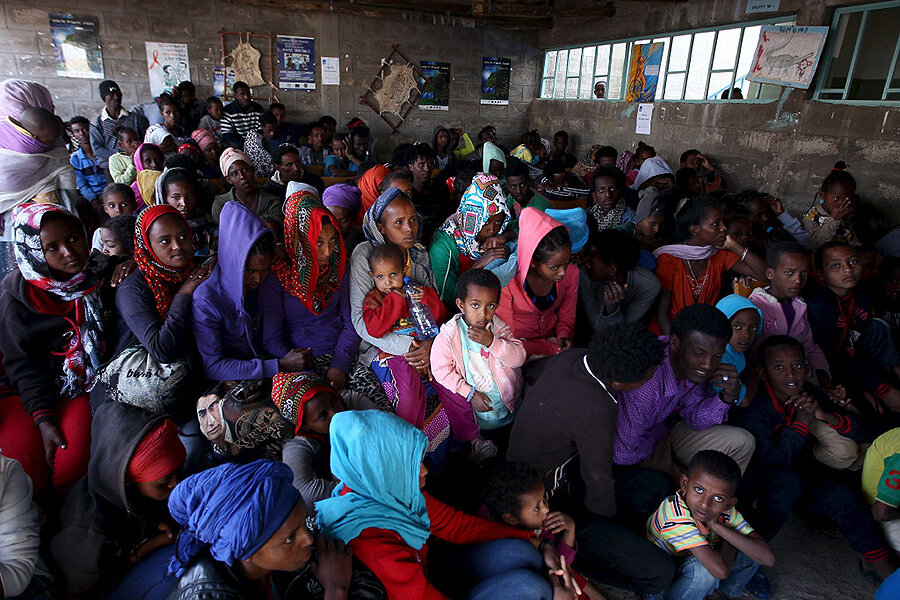
ADDIS ABABA, July 12 (Xinhua) -- A total of 6,186 refugees were registered in the month of June in Ethiopia, pushing the number of refugees registered in the East African nation to 843,374.
The figure was given on Wednesday by the United Nations High commission for Refugees (UNHCR) which said the June refugee arrivals have pushed the number of refugees registered in Ethiopia in the first six months of 2017 to a total of 60,293.
UNHCR gave the figures as it works to highlight the funding gap it is facing to meet the needs of the refugees currently estimated at 307.5 million U.S. dollars. So far 23 percent of the needed 307.5 million U.S. dollars has been donated to UNHCR.
Most refugees in Ethiopia come from the strife- torn nations of Somalia and South Sudan and Ethiopia's northern neighbor Eritrea.
Smaller groups of refugees fleeing war in Sudan and from across the Red Sea from Yemenare also part of the group the UNHCR has registered as refugees in Ethiopia.
With Ethiopia currently being among the top five refugee hosting nations in the world, it's also one of five African countries participating in a Comprehensive Refugee Response Framework (CRRF).
CRRF is a vehicle for the implementation of pledges made at UN leaders' summit in September 2016 in New York, where refugees in Ethiopia will be given funds for assisting with education and employment opportunities in Ethiopia.
Western Countries in particular hope that schemes like CRRF will persuade refugees living in Ethiopia and other African nations not to undertake perilous trips to reach their countries and instead stay at their current host countries.
African migrants currently in Libya who qualify as refugees will be legally resettled to the European Union, according to the European Commission.
The surprise announcement, one of a number of "immediate measures" made in a new EU Action Plan, is designed to tackle an increasingly urgent phase in the ongoing Mediterranean migration crisis.
"All actors now need to intensify and accelerate their efforts in line with the increasing urgency of the situation and the commitments undertaken by EU leaders," the plan states.
The Commission, the executive arm of the EU, published the measures after an overwhelmed Italian government threatened to block entry to Italian ports for all aid ships who rescue and recover migrants trying to cross from Libya to Italy.
Migrant arrivals in Italy are up nearly 19% over the same period last year.
EU figures estimate that 85,183 people, from countries all over Africa, have been rescued while attempting the deadly crossing. Ninety-five percent leave Africa from the Libyan coastline in flimsy boats.
The relocation pledge from Libya is an extension to existing relocation programmes focused on refugees in Turkey, Jordan and Lebanon, from where 17,000 mostly Syrian refugees have been resettled.
"The Commission will launch a new resettlement pledging exercise in conjunction with the UNHCR starting with those in need of international protection from Libya, Egypt, Niger, Ethiopia and Sudan" the new pledge states.
The commission document, called 'Action plan on measures to support Italy, reduce pressure along the Central Mediterranean route and increase solidarity' will form the basis of discussions at an EU interior ministers meeting in Estonia on Thursday.
The document contains a series of new measures including renewed impetus on training and equipping Libyan border and coastguard operations, as well as an official code of conduct for charities involved in search and rescue missions in the Mediterranean.
Charities have been accused of encouraging the pull of migrants by providing rescue missions. They deny this, pointing out that the migrants were making the journeys in similar numbers before they operated in the region.
Other measures in the Action Plan include €35m (£30.7m) in extra cash for Italy to help the government in Rome deal with the crisis.
Migrants travel to Libya from countries all over Africa - Eritrea, Ethiopia and Sudan in the east, Mali and Niger in the centre and from Nigeria, Senegal, Guinea, Ivory Coast and Gambia in the west.
More than 2,000 are known to have died this year alone according to the International Organisation for Migration.
Around 50 migrants were missing, feared dead, off the coast of Spain on Tuesday. If confirmed, it would make the voyage the deadliest sea crossing in that part of the Mediterranean this year.
Survivors are routinely brought to Italy by charity rescue vessels because Libya is not considered a safe country for them to be returned to.
Charities including the Italian Red Cross have repeatedly warned that Italy's overcrowded reception centres are in a critical state and cannot cope with the overwhelming number of asylum applications.
Sky News has spoken to numerous migrants who have walked out of the centres after an initial registration process which includes fingerprinting. Many make their way to Rome en-route to northern Europe.
European Commission President Jean-Claude Juncker said: "The dire situation in the Mediterranean is neither a new nor a passing reality."
"We have made enormous progress over the past two and half years towards a genuine EU migration policy but the urgency of the situation now requires us to seriously accelerate our collective work and not leave Italy on its own.
"The focus of our efforts has to be on solidarity - with those fleeing war and persecution and with our Member States under the most pressure.
"At the same time, we need to act, in support of Libya, to fight smugglers and enhance border control to reduce the number of people taking hazardous journeys to Europe."
Last September, Sky News witnessed the perilous crossings from the deck of a rescue vessel run by the charity Migrant Offshore Aid Station (MOAS).
In the nine months since then, the situation has deteriorated.
MOAS and other charities who operate rescue vessels have repeatedly called for "safe and legal routes" for migrants so that they don't resort to deadly sea crossings fuelled by people traffickers.
Cultural similarities have helped Ethiopia absorb more than 160,000 refugees from Eritrea, despite a still-bitter border dispute. But the government has also put out the welcome mat for strategic reasons, at a time when many countries are doing the opposite.
BADME, ALONG THE ERITREAN-ETHIOPIAN BORDER —When Yordanos and her two young children slipped safely across the Mereb riverbed between Eritrea and Ethiopia late one recent night, they thought the worst of their journey into exile was over. The smuggler had done his job, and they were safely over the border.
Then they heard the hyenas.
Yordanos and her children began to yell for help, their panicked calls fading into the solid darkness. Suddenly, she saw a group of Ethiopian soldiers coming towards them. The men comforted the young families, and then escorted them to the nearby town of Badme. “They were like brothers to us,” says Yordanos, who asked that her last name not be used for fear of reprisals from the Eritrean government against her relatives at home.
In some regards, Ethiopia – and in particular this sliver of Ethiopia’s arid north – is the last place you might expect an Eritrean refugee like Yordanos to receive a warm welcome. In 1998, after all, an Eritrean invasion of this sleepy border town touched off a two-year war between the two countries that cost tens of thousands of lives and more than $4.5 billion, along with destroying most of the then-flourishing network of trade between the two countries. And before that conflict, Eritreans fought a 30-year civil war for independence from Ethiopia, which ended only in 1991.
Even today, the ashes of those conflicts still smolder. The internationally-brokered peace settlement ending the 1998-2000 war decreed that Ethiopia should give this region of the country back to Eritrea, which claims it as historical land. But Ethiopia never did, and border clashes between the two countries’ militaries continue into the present.
Still, Yordanos’ story is not uncommon. Fleeing enforced, indefinite military service, illegal imprisonment, and torture, about 165,000 Eritrean refugees and asylum seekers currently live in Ethiopia, according to the United Nations. Upon arrival and registration, they are automatically granted refugee status, and the country continues to welcome more. In February of this year alone, 3,367 new Eritrean refugees arrived in the country, according to Ethiopia’s Administration for Refugee and Returnee Affairs (ARRA).
“We differentiate between the government and its people,” says Estifanos Gebremedhin, the head of the legal and protection department at ARRA. “We are the same people, we share the same blood, even the same grandfathers.”
The reasons for that openness, indeed, owe much to shared history.As in many parts of Africa, colonialism sliced much of this region apart in illogical ways (though Ethiopia itself was never colonized), sowing political conflicts between members of the same community that have persisted to the present day. For much of the roughly 600-mile Ethiopian-Eritrean border, people on both sides share the same language – Tigrinya – as well as Orthodox religion and cultural traditions.
“It’s only the Eritrean government creating problems, not the people,” says Benyamin, a resident of Axum, a town in Ethiopia’s northern Tigray region, who didn’t give his last name. “I haven’t got relatives in Eritrea but many people here do. Some from the refugee camps go to the university here.”
But there may also be more strategic reasons for Ethiopia’s open-door policy, experts say.
“Ethiopia strongly believes that generous hosting of refugees will be good for regional relationships down the road,” says Jennifer Riggan, an associate professor of international studies at Arcadia University in Pennsylvania, who studies Eritrean refugees in Ethiopia.
There’s also an increasing amount of money in hosting refugees, some highlight,as the international community tries to block secondary migration to Europe. One recent example was the joint initiative announced by Britain, the European Union, and the World Bank to fund the building of two industrial parks in Ethiopia to generate about 100,000 jobs, at a cost of $500 million, with Ethiopia required to grant employment rights to 30,000 refugees as part of the deal.
It might also be a way of countering international controversy about the Oromo protestsand shoring up Ethiopia’s standing in the world, according to Milena Belloni, a researcher in the Department of Sociology at the University of Antwerp in Belgium, who is currently writing a book about Eritrean refugees. The protests, which roiled the country's largest region throughout 2016, have prompted a government crackdown that left hundreds of Ethiopians dead and sharply curtailed basic freedoms, according to human rights groups.
Either way, Ethiopia’s approach is in marked contrast to the strategies of reducing migrant flows that are being adopted in much of the West, Dr. Riggan says.
“Ethiopia's response is to manage the gate, and figure out how it can benefit from these inevitable flows of people,” she notes. “I definitely think Ethiopia's approach is the wiser and more realistic one.”
After Yordanos, her children, and another mother and her two children who crossed with them were collected by the soldiers near Badme, they were taken into town and left at a so-called “entry point,” a cluster of disheveled government buildings. From there, refugees join the bureaucratic and logistic conveyor belt that assigns them asylum status and moves them to one of four refugee camps in Ethiopia’s northern Tigray region.
There, relationships between refugees and locals do sometimes grow strained, particularly as both groups compete for scarce shared resources like firewood and cattle pastures. And many Eritrean refugees regard Ethiopia as only a stopover point on their journey to the West. In 2013, there was unrest in all four camps, with riots in two camps, Adi Harush and Mai Aini, when refugees demanded more opportunities for international resettlement and protested authorities' alleged corruption.
“People recognize the shared culture and ethnic background, and that helps for many things, but there’s still distrust because of the 30-year-war [for independence], and mostly due to 1998-2000 border conflict and related mass displacement,” says Dr. Belloni. “There’s a double narrative.”
In addition to the camps, meanwhile, thousands more Eritreans live in Ethiopia outside the asylum system, both legally and illegally. About 650 miles south of the border, in the capital Addis Ababa, whole neighborhoods function as Eritrean enclaves, where the distinctive, guttural sounds of Tigrinya pour out of cafes with Italian-sounding names like Lattria Piccolo, a nod to Eritrea’s history as an Italian colony.
The prospect of a better life elsewhere is on everyone’s lips in rural Ethiopia - Tobias Hase/DPA/ZUMA
While the EU seeks an agreement with Libya to halt the influx of migrants across the Mediterranean, the prospect of a better life elsewhere is what all in rural Ethiopia talk about.
AGARFA — A soldier chews on a leaf of khat, a mild stimulant, and spits it on the ground. "Hey you, ferenji, how much do you want to take me with you to Italy?" he asks me, laughing with his comrade. Ferenji means stranger in Amharic, Ethiopia’s official language.
In the small, far-flung town of Agarfa, in the province of Bale, the soldier is working security at an event organized by Medical Collaboration Committee (CCM), an Italian NGO. The CCM has come to this town, which lies 280 miles away from the capital of Addis Ababa, to educate locals on the risks of illegally migrating to Europe.
Mohammed, the local imam, asks to speak. "I haven’t heard back from four of my children," he says, holding back tears. "I know nothing, they’ve disappeared. I had warned them not to go."
Mohammed’s words clearly have an effect on those attending the meeting; the women around him hide behind their hijabs or begin to cry openly.
While the European Union seeks an agreement with Libya to halt the influx of migrants across the Mediterranean Sea, the prospect of a better life elsewhere is on everyone’s lips here in rural Ethiopia. Some have relatives in Europe, the United States, or in the Arab world; some have families stuck in migrant welcome centers in Libya; some have attempted the journey and were sent back; some cry over their loved ones who didn’t make it out; and some just want to leave.
According to the United Nations High Commissioner for Refugees (UNHCR), the country’s strategic location in the Horn of Africa — the region comprising Ethiopia, Somalia, Eritrea, and Djibouti — and local political instability contributed to rising emigration from Ethiopia in recent years. There has been a growing exodus since 2015. About 740,000 Ethiopians now live abroad. Ethiopia itself is home to the largest number of refugees in Africa, housing 670,000 refugees in camps along its borders with Eritrea, South Sudan, and Somalia.
The province of Bale has one of the highest emigration rates in the country. Images of Italian soccer star Mario Balotelli are emblazoned on the tuk-tuks — known here as Bajaj — that fill the streets in the cities of Robe and Goba. People don’t seem to care that Balotelli is of Ghanaian origin and was born in Palermo; what matters is his success and the color of his skin.
"People leave because there’s no work here," says Abdulkadir Gazali, a 39-year-old father of five. "I tried going to Saudi Arabia three times, but they always sent me back."
It might appear easy to leave as long as you have money to pay smugglers.
"It costs 400 to 600 euros ($420 to $640) to reach an Arab country," says Waldayese, head of immigration at Bale’s department of social affairs.
The price for migrating to Europe is much higher. It can cost up to 4,000 euros ($4,245). The entire practice is illegal, of course.
"Young people collect the necessary funds by selling livestock or working in the fields," says Waldayese.
In Egypt, the United Nations High Commissioner for Refugees (UNHCR) has been the target of bitter criticism and even violent protest this year.
Protests at the agency's Cairo headquarters – including one man setting himself on fire – have been led by Oromos, the single biggest ethnic group in Ethiopia.
The Oromos say the UNHCR – which by agreement with the Egyptian government has responsibility for determining asylum applications in Egypt – has routinely rejected their asylum claims. The Oromos claim the UN agency has been hostile to their allegations of discrimination, persecution and even torture by the government of Ethiopia. Protests and a government crackdown in Ethiopia have left 140 (the government estimate) or 314 (Human Rights Watch) dead since July and pushed thousands of people to flee the country.
UNHCR said the criticism is unfounded. It conceded there had been delays to processing applications but said those were caused by a shortage of resources.
It was "absolutely not true to say we reject everyone," said Tariq Argaz, a UNHCR spokesman.
Nevertheless, an increasing number of Oromos in Cairo have tried to get to Europe this year. Almost half of the estimated 150 Ethiopians who drowned in a sinking on April 9 joined the voyage straight from the UNHCR protest, according to relatives and survivors, who said the UN agency effectively pushed them to risk the dangerous journey across the Mediterranean.
"We have come to feel in Cairo, it is Europe or death!" said Arafat Abdulrahman, an Oromo who lost several friends in the April disaster. He set off for Italy himself and arrived safely in July.
SELF IMMOLATION
Muaz Mahmud, the Oromo migrant who lost his wife Duniya and their two-month-old baby in the shipwreck, is furious with the UN. "If our case had been taken seriously we would have waited for the UN to make a decision," he said. "We wouldn't have dared to leave. But we lost hope."
Mahmud, 25, said he fled Ethiopia after being arrested for protesting. He said police had tortured him with electric shocks. "'You don't have the right to speak,'" he said they told him. "'If you want to be silent and live silently, you go ahead and live silently.'"
Mohammed Seid, public relations director of Ethiopia's Office for Government Communications Affairs, said no law-abiding citizens had reason to fear the government.
"Ethiopia is governed by rules," he said. "Opposition activity that is not criminal in nature, or does not involve violence, is not illegal in Ethiopia."
Seid said that Oromos who make it to Europe or the United States often lie to win asylum. "In their bid to find shelter, or be handed green cards, residency status or have their asylum bids accepted, any pretext is claimed," he said. "But the main reason is economic ... Traffickers lure them through false promises of easy wealth."
In late April, UNHCR in Cairo agreed to work with Oromo groups to resolve the growing dispute there. But 40 or so refugees remained camped outside the agency's office. In July, Getu Ayana, 26, doused himself with petrol and lit a match. Another migrant, Asli Nure, tried to put out the flames. Her clothes caught alight, and both died. According to other Oromos, the self-immolation was in protest at the high number of rejected asylum claims.
Argaz, the UNHCR spokesman, said staff helped get the two medical attention. He said every refugee application is treated on its merits and processed in a transparent and fair way.
Abdo Mohamed, chairman of the Oromo Sons Refugee Association in Cairo, said frustrations remains. "The UNHCR have promised to work on this issue but they are still rejecting people," he said.
EU supports fresh start for returnees in Ethiopia
With restrictions on migration tightening in Europe, many would-be asylum seekers from Ethiopia are choosing to return home. An organization funded by the European Union is helping them to return to their country.
Illegale Migrantenin Addis Abeba, Äthiopien (DW/C.Wanjohi)
According to the International Organization for Migration (IOM), in the last couple of months thousands of illegal Ethiopian migrants have been forced to return home from countries like Yemen, Zambia, South Africa, Tanzania and Saudi Arabia. As of yet there is no official data about Ethiopians expelled from Europe.
Those Ethiopians who come back are disillusioned and desperate, because they failed to reach the goal they risked their lives for. The biggest challenge they face once they are back is how to begin anew. Many have debts towards those who helped them finance the trip abroad. And they have no means to pay them.
An end to suffering
A lucky few are getting a chance to start their own business. About 30 returned migrants are currently getting training at the local non- profit organization LIVE-Addis. Recently they presented their business plans to LIVE-Addis. They now hope to be self-employed in a couple of weeks.
Among them is Alazaar Beshaf. He went to Dubai in 2014, following a friend's advice. He was told that he would get a better job there. A high school dropout with no legal documents, Beshaf failed to get a visa when he reached Dubai. After five months he returned home to Ethiopia. He told DW: "It was very hard for me in Dubai. I suffered a lot and for five months even the street gangsters were out to kill me"
Illegale Migranten Äthiopien, Alazar Beshaf (DW/A.Abeba)
Alazaar Beshaf returned to Ethiopia from Dubai
Bread for the neighborhood
When Beshaf returned to Addis Ababa, he approached LIVE-Addis. The organization provides assistance for returnees and to victims of human trafficking. Alazaar Beshaf has completed a 21-day training course on business management sponsored by LIVE-Addis. He feels confident that he can now start his own business.
His plan is to make injera, a soft, spongy, pancake-like bread which is very popular in Ethiopia. He aims at selling his product to the residents of his area. “Sixty thousand people live there. But there is no injera on offer, so they have to buy it somewhere else." Beshaf already owns two stoves but needs four to give his business the necessary start. "LIVE-Addis will give me some money and I will buy the other two stoves," he said.
The EU steps in
Illegale Migranten Äthiopien Alemayehu Teshome (DW/C.Wanjohi)
LIVE-Adiss' director Alemayehu Teshome promises quick help for returnees
EU leaders agreed in October to step up their efforts to curb illegal migration. To staunch flows along the so-called central Mediterranean route, the EU is offering trade deals and investment to African countries. In exchange for financial support African partners are to impose tighter border controls and to take back illegal migrants. This new approach by the EU is currently being applied in five African countries: Niger, Nigeria, Mali, Senegal and Ethiopia.
Alemayehu Teshome is the executive director for LIVE-Addis, an organization funded by the European Union. He pointed out that they carefully vet the business plans presented by the future businessmen and things normally run smoothly. "It might not take us more than two weeks after the approval to provide them with start up capital," he told DW.
The organization will then link the aspiring businessmen and women to the local administration to help get them all the licenses they need. Teshome also said LIVE-Addis also assigns community facilitators for technical support and advice when they really start their own businesses for at least six months after the new businesses have opened. Beshaf and the 31 other returnees on his course now have a chance to be successful in their own country.